


Salt Lake City trees add shade, character, and habitat to neighborhoods, but they also face stresses from dry summers, compacted urban soils, winter snow, wind, and construction activity. A few minutes of observation can help homeowners notice changes before a branch, trunk, or root problem affects a home, driveway, sidewalk, or gathering space. When concerns go beyond a basic walk-around, a tree risk assessment by certified arborists in Salt Lake City can help identify what the visible signs may mean. A tree that looks uneven or drops a few leaves is not automatically dangerous. Risk depends on the tree’s condition, the type of defect present, whether the condition is changing, and what could be hit if a branch or trunk fails. The goal is not to diagnose every issue from the yard. It is to recognize warning signs, avoid unsafe do-it-yourself work, and act promptly when people or property could be in harm’s way.
Why Early Warning Signs Matter
Many tree problems develop gradually. A small crack can widen, root damage can reduce stability over time, and a dead limb can remain in the canopy until wind, rain, snow, or ice brings it down. Early attention creates more options. For example, a dead branch above a driveway may be manageable when spotted early, but it becomes an immediate concern when a storm is approaching or vehicles park beneath it. Pay particular attention to recent changes. New leaning, fresh splits, broken limbs, lifted soil, or a sudden gap in the canopy deserve more attention than an old, stable-looking scar. Conditions that appear after excavation, grading, lawn replacement, or a severe weather event should not be ignored.
Start With a Safe Walk-Around
A ground-level inspection is a sensible starting point. Do not climb the tree, pull on branches, probe cavities, dig around roots, or stand under limbs that look damaged. Walk around the full tree from several angles and look for changes in its shape, lean, canopy, trunk, and surrounding soil.
- Check whether the tree leans toward a house, garage, road, walkway, play area, or parked vehicle.
- Look for fresh fallen twigs, bark, limbs, or soil disturbance after a storm.
- Keep children, pets, and visitors away from hanging branches or visibly unstable ground.
- Note branches that extend over places where people regularly walk, sit, or park.
Check the Trunk and Bark
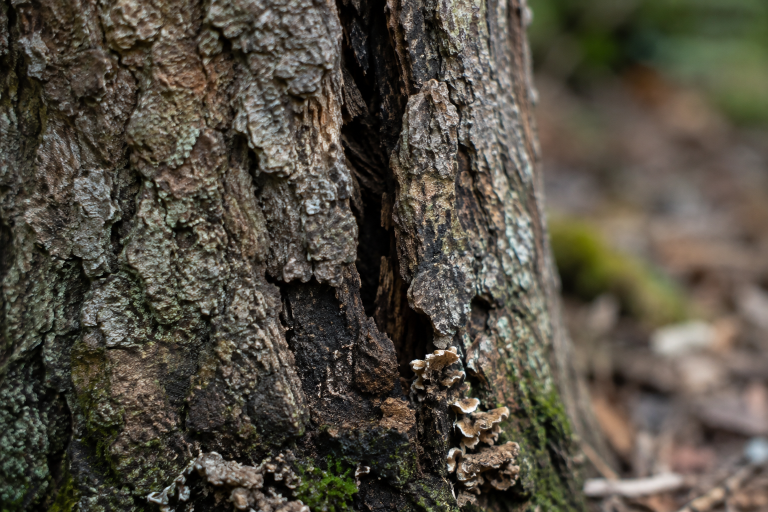
The trunk can reveal important clues about a tree’s structure. Look for deep cracks, long splits, large cavities, soft or decayed-looking wood near the base, unusual swelling, open seams, and major wounds from vehicles, lawn equipment, lightning, or construction. Mushrooms or shelf-like fungal growth on the trunk or around the base may also warrant closer evaluation, as they may be associated with decay. One feature alone does not prove a tree will fail. Some trees live for years with old wounds or cavities. Concern increases when several signs appear together, when the defect is new or worsening, or when the affected part could strike a valuable target below.
Look Up at the Canopy
View the crown from a safe distance rather than directly beneath it. Dead branches, broken limbs caught in other branches, narrow or weak-looking branch attachments, and large limbs with heavy weight concentrated at their ends all deserve attention. Also watch for an uneven canopy, bare sections, branches rubbing together, or limbs close to utility lines. Canopy health matters, but it should be interpreted in context. Thinning leaves, early color change, and dieback can reflect stress, pests, disease, root problems, or water-related issues. In Utah landscapes, late-summer leaf scorch can occur during periods of heat and low humidity, so browning leaf edges alone do not necessarily indicate structural damage.
Inspect the Root Zone
The area around the trunk is as important as the branches overhead. Look for newly lifted or cracked soil, mounding at one side of the base, exposed or broken roots, standing water, erosion, or a new change in lean. Soil movement near the base can be especially concerning when it accompanies a leaning tree. Roots often extend beyond the canopy edge, which is why trenching, pavement work, grade changes, and soil compaction can affect a tree even when the trunk appears untouched. Utah State University notes that damaging tree roots and trunks during lawn removal can create avoidable stress, making careful planning around established trees important.
Watch for Health Problems
Tree health concerns may overlap with safety concerns, but symptoms should not be treated as a diagnosis. Watch for repeated branch dieback, unusually small or sparse leaves, premature leaf drop, oozing sap, staining, holes from insect activity, fungal growth, or stunted new growth. Drought, overwatering, soil compaction, pests, disease, chemical exposure, and root injury can produce similar symptoms. A useful rule is to compare the tree with its own past condition and with nearby trees of the same type. A sudden decline or a problem limited to one major limb may be more meaningful than a minor seasonal change seen throughout the neighborhood.
Consider Weather and Location
The same defect can represent very different levels of concern depending on location. A small dead branch over an unused corner of a yard may require monitoring, while the same branch over a front walk, deck, roof, or driveway deserves faster action. Consider wind exposure, snow and ice accumulation, drainage patterns, recent drought, and any nearby structures or utility lines. After a storm, inspect from the ground once it is safe to do so. Do not approach downed lines or branches touching electrical equipment. Treat a tree near power lines as a professional utility-safety issue, not a pruning project.
Know When To Call an Expert
Request Professional Help Promptly When:
- A tree has suddenly begun leaning, or the soil around its roots is lifting.
- Large cracks develop in the trunk, major limbs, or branch unions.
- A substantial branch is broken, hanging, or extending over a structure.
- Decay, a cavity, or fungal growth appears near the base of a large tree.
- The tree has sustained major storm, vehicle, or construction damage.
- Branches are touching or close to power lines.
- The tree is too large or damaged to assess safely from the ground.
Professional assessment considers the tree, its defects, and the targets within reach. As guidance on managing tree hazards and risk explains, possible responses may include pruning, weight reduction, support systems where appropriate, or removal when risk cannot be reduced to an acceptable level. Never use a chainsaw on an unstable tree or attempt work near energized lines.
What To Document During an Inspection
Clear notes and photographs can make a later evaluation more useful. From a safe distance, record:
- Wide photos showing the whole tree and its surroundings.
- Close photos of cracks, cavities, fungi, damaged bark, or hanging limbs.
- The date the condition was first noticed.
- Recent weather, flooding, drought, construction, or landscaping changes.
- Homes, vehicles, walkways, play areas, or lines within the potential fall area.
Conclusion
Not every warning sign means a tree must be removed. Some trees may benefit from monitoring, targeted pruning, improved watering practices, cabling or support where appropriate, or treatment for an underlying health issue. In Salt Lake City, regular observation is a practical way to protect both valuable trees and the places people use every day. Homeowners can watch for changes such as dead or hanging branches, cracks in major limbs, leaning, damaged roots, fungal growth, or unusual changes in foliage. Keeping trees properly watered and avoiding unnecessary damage to trunks and root areas can also support routine care. Notice changes early, avoid unstable areas, and seek qualified help whenever a tree could threaten people, property, vehicles, structures, or utility lines. Early professional assessment can also help determine whether monitoring, maintenance, or removal is appropriate.

